Here’s an article from Polo Players’ Edition of June 2003. Read it carefully because, in my not-so-humble opinion, it’s the definitive sports article, i.e. the only one to derive the swing from first principles. When you’ve read and understood it, you’ll know what you’re doing and will have placed your game on a solid footing. Study it carefully, incorporate its idea into your swing, and prepare to play well enough that people say “he’s a member of the Nickawampus Polo Club. “
-
Anytime you’re trying to propel a ball through space, which includes virtually all sports, you’re doing it the same way. This explains why some people are good at so many sports, Wayne Gretsky, Mario LeMieux, Pete Bostwick, Charlie Menditeguy. They know the secret to good shot making, and use it no matter what game they’re playing. So let’s learn their secret and play all sports, tennis, golf, polo, or anything else, well.
The player on the far end is Welby Van Horn, who was finalist in the 1939 U.S. Open to Bobby Riggs. The player on this end is you, the viewer and member of the Nickawampus Polo Club. You have a stop in your swing just as Welby does, and you impart all that pace to your forehands and backhands just like he does, by angular momentum.
He brings the racket along the line of the shot, then pulls it at a greater and greater angle, to speed up the racket and thus the shot. And you do too. These good tennis shots will be the foundation of your good polo shots, which operate from the same principles, and are achieved the same way.
Yes, we members of the Nickawampus Polo Club play all sports well.
-
There’s a reason every sport has a few good players and everyone else struggles in frustrated mediocrity. And here it is.
The hands in this animation are those of the immortal Ben Hogan, drawn by Anthony Ravielli for Ben’s unrivaled book, Five Lessons. Notice how he pulls the club along in line with the intended shot. Then he starts to pull the club handle away from that line, at a greater and greater angle, until he’s pulling the handle at a 90o angle to the shot. This produces angular momentum.
His hands, describing an arc, move at a constant speed, while the clubhead speeds up, reaching its maximum speed just at the ball, and then very rapidly slows down. Also, and here’s the secret we promised, the swing has a stop in it…the hands coming to a dead stop just as the club meets the ball.
This secret distinguishes good players. So practice it, with a golf club, a tennis racket, or a polo mallet. The ball will start jumping with all that acceleration that you’re putting on it. And your game, and confidence, will build accordingly.
Welcome to the Nickawampus Polo Club. You’re a real member now.
-

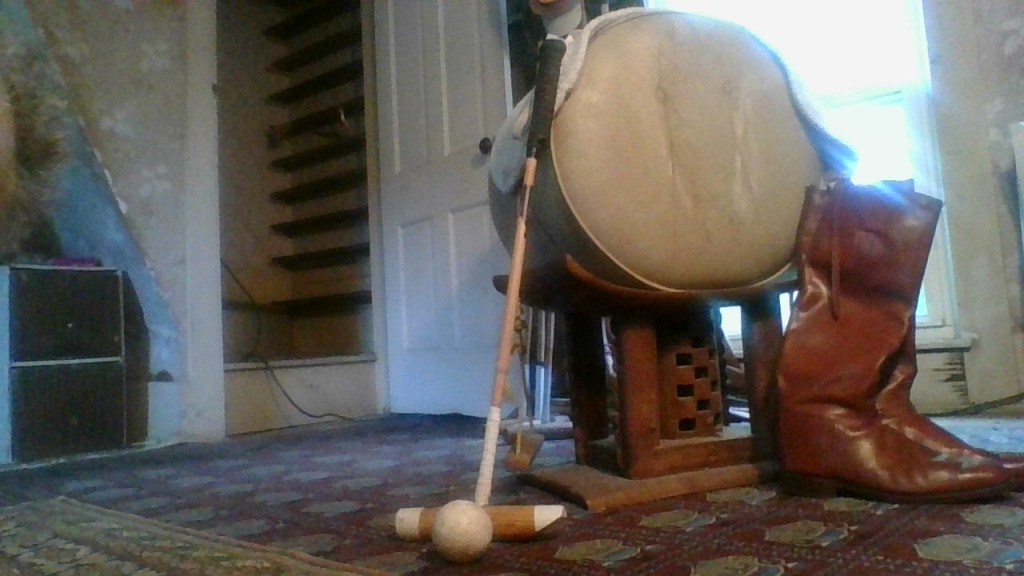
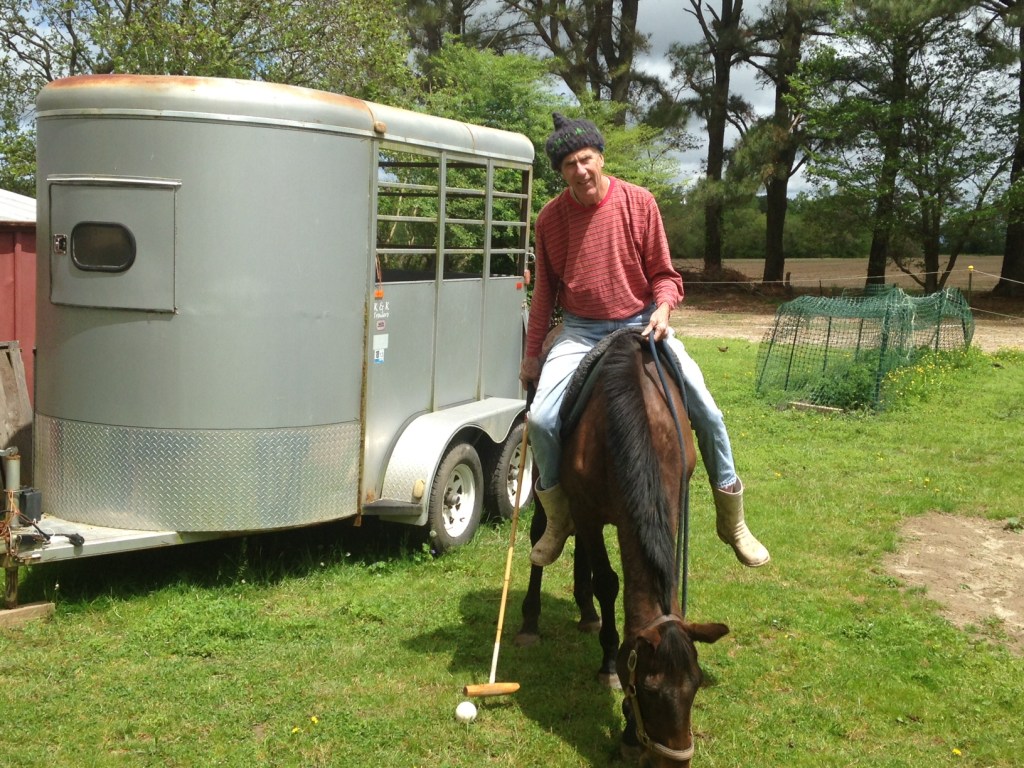
Look carefully at the first photo. Those are a few of the most important horses in my life, from the porch bannister, to Trixie, our childhood pony, to Old John, whom tyros drew on the ranch, to lovely Raisin, my first polo love.
The third picture features me on “Don,” aka Prince Bohemond, a son of Cannonade, who won the 1974 Kentucky Derby, the first year after Secretariat. And notice that he’s grazing, not running, and I’m having a high old time, tapping the ball. The most difficult part of polo is getting enough practice, and you can accomplish that if you do it this way.
Now, look at the second photo, of a practice pony that I keep in my library. What about those cold, windy winter nights when you want to practice. Here’s how.
If you’re resourceful, and determined, you’ll be able to practice all you want and build real skill, so that when you’re on a cantering horse, on a field, you’ll be prepared, play well, and really enjoy it.
-
Here are four photos that trace my development as a rider, from the upper left, sitting on the bannister of the front porch, to my childhood pony Trixie, who was a livin’ doll, to Old John, the horse tyros drew on the ranch, to lower left, Raisin, my first polo love. The picture was taken on a bright summer morning at the Empire Polo Club, and the rider behind me in the photo is my cousin Jim, who still participates in the steer roping at Sheridan at the age of eighty.
Wonderful horses all, and I have fond memories of each one.
-
Recently I was chatting with friends about polo, and as an exaggeration, I said “to get to the top in polo, you don’t necessarily need to play well, but you must have a snappy decal for your trucks and equipment.” Of course, I was being facetious. The game we love is difficult, takes long years, facts we all know. But one can’t help noticing and being impressed by trucks and service vehicles with Grant Manor Farm, or Gehache, or GreenTree logos, which add to the overall allure.
In that spirit, I dug out an old drawing to see about turning it into a decal. Here it is:
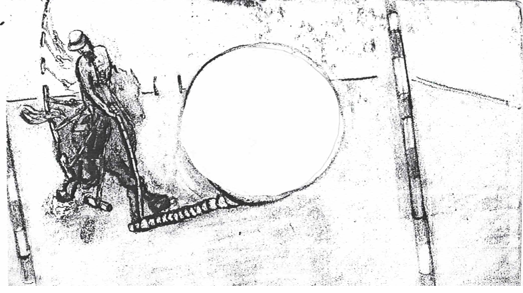
Just when I was starting polo for the second time in the early 90’s (we had Palmetto Polo in Hereford, TX in the 50s, my dad having written “Polo On The Plains” for the Cattleman Magazine in September, 1954), I drove up to Montecito for an interview with polo legend Bob Skene. To produce the video, “A Visit With Bob Skene,” I used this drawing to frame the credits. The player would swoop down on goal, rip a great shot, the credits appearing on the ball as it zoomed through the goal.
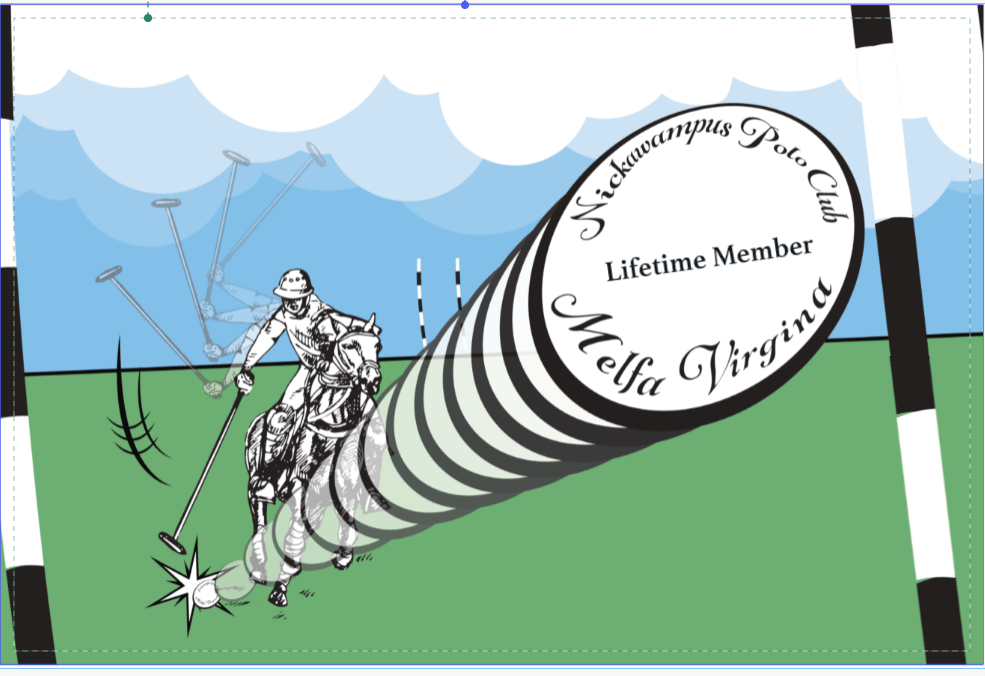
Following the jokey conversation above, I sent the image off to Vista Print and they came back with this design for the decal, and here it is.
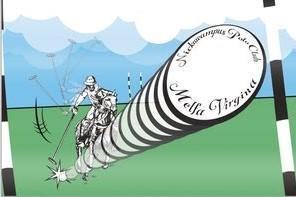
With this added bonus. The design team at Vista didn’t want to work with my drawing, it being too difficult to add definition to the horse, so they produced an image of a high goal player, using the original design, for this whopping decal.
In the discussions with Vista, it came up that the drawing is essentially a lesson, and a vitally important one for anyone wishing to hit good shots. If you look carefully at the player’s wrist, it curls in at the last moment. He’s reducing the radius, putting all that oomph on the ball which is the hallmark of the good player, and of good play.
So here’s an unexpected benefit to the decal. Every time I get in my truck I study the drawing on the decal and import its idea into my swing, getting a great, recurring lesson. You can have one too. Send $50 along with your mailing address to the Nickawampus Polo Club, P.O. Box 311,Melfa, VA 23410, to get your decal and a frequent reminder of this essence of good play. You’ll not only arrive in polo, you’ll have a game when you get there.
-
Hitting a ball well in any sport takes a lot of practice, and also some thought. Tennis or golf are good examples of how difficult hitting good shots can be. In polo, when you’re on horseback, the difficulty is only compounded. But having a reliable, inexpensive practice venue is very helpful, and having a clear idea of what to do and why is invaluable.
The principles of hitting any ball are the same. To begin with, start small, hitting small shots on a rug, with a foot mallet, trying to get the ball to take a little jump off the mallet. Practice this a lot, as all good players have, and don’t hurry. Here is where you build confidence. Here is your polo-physics lab, which is key to the progress ahead.
-

Here is your starter polo kit. It consists of a “pony,” a foot-mallet, and a polo ball. As a new member of the Nickawampus Polo Club, we can supply you with all three. Send your mailing address to NPC, P.O. Box 311, Melfa, VA 23410, and you will receive your starter kit in the mail. In the meantime, be thinking of where you will install your practice pony. You’ll spend a lot of time getting used to riding, and also coordinating the unusual posture on horseback to using the mallet to address the ball. And although it sounds unnecessary, think of a name for your pony. He’s going to be the foundation of your game and also, depending on how much you put into it, your best friend.
-
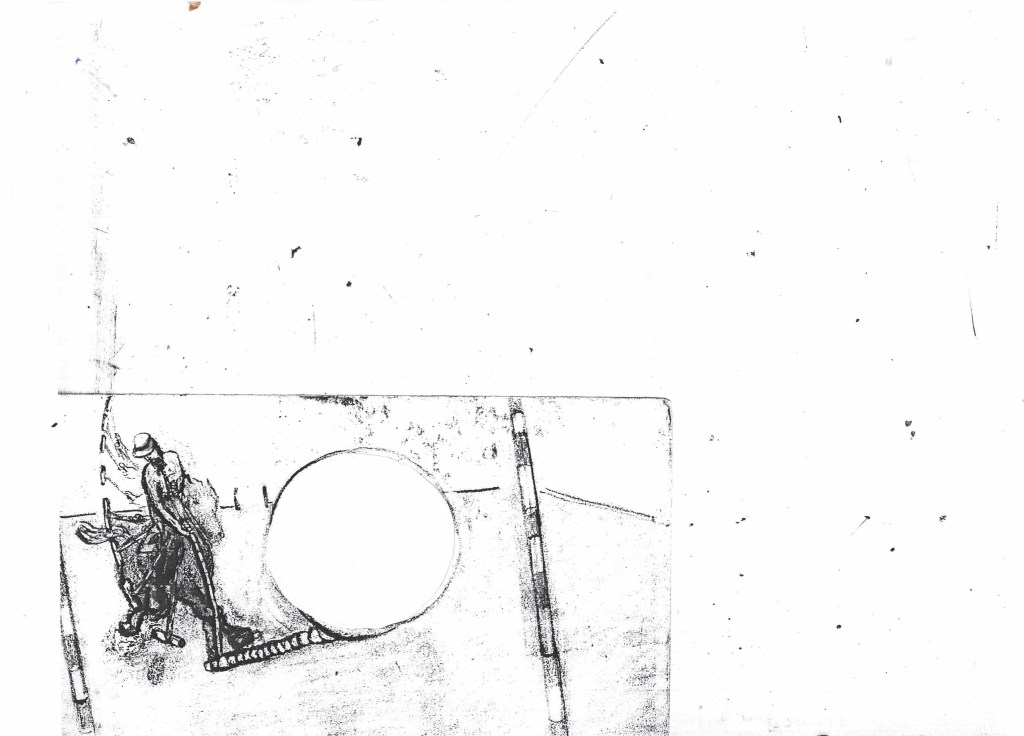
Here you are, closing on goal on your trusty pony. Sound far-fetched? Well, yes, it is, but not nearly as far-fetched as you think. You’ll meet this pony, do some riding and some (very gentle) hitting, and the thrill of polo will become more real than you ever imagined. Next time, meet your pony. Be thinking of a good name for your trusty equine friend.
 NickawampusPoloClub